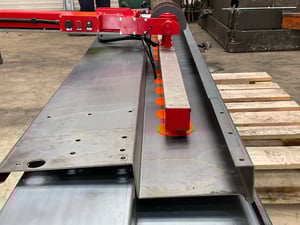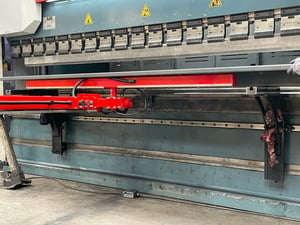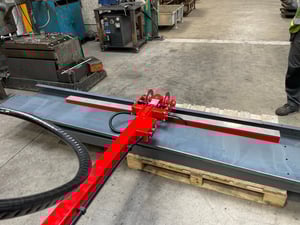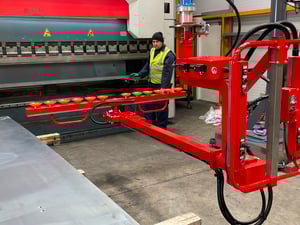
Sheet metal moves through nearly every stage of industrial production: cut, stacked, rotated, loaded, and each transfer carries risk.
A single sheet can weigh dozens of kilograms, carries edges sharp enough to cause serious lacerations, and shifts unpredictably when lifted by hand. Handling sheet metal well is less a matter of caution and more a matter of process: how the material moves determines how often people get hurt, sheets get damaged, and a line stops. This is what changes when a facility moves from manual handling to mechanised handling: the risks, where they hit hardest by sector, and what actually shifts on the floor once the equipment does the lifting.
On this page:
- The real risks of handling sheet metal by hand
- Handling sheet metal across industrial sectors
- How RHS handles sheet metal
The real risks of handling sheet metal by hand
Handling sheet metal by hand exposes workers to two distinct risks: acute injury from sharp, unpredictable edges, and cumulative strain that builds up long before an incident is ever logged.
- Cuts and strain: lacerations from exposed edges are the most visible risk, but not the only one. Repeated bending, twisting, and carrying a sheet close to the body strains the back and shoulders over time. Add the awkward geometry of a large, thin sheet, poor grip, unpredictable flex, no natural handhold, and even trained staff struggle to lift consistently within safe limits.
- Weight and thickness: the two do not carry the same risk. A thin sheet flexes and can bend or dent under its own movement; a thicker sheet of the same size is simply heavier to control. Two sheets of identical dimensions can carry very different handling risk depending on gauge alone.
- Technique has a limit: most safety guidance stops at gloves, correct lifting posture, asking for help above a manageable weight. Necessary, but it treats the symptom. Manual handling has a hard ceiling, in weight, in sheet size, in repetition rate, and past it no technique removes the risk.
Handling sheet metal across industrial sectors
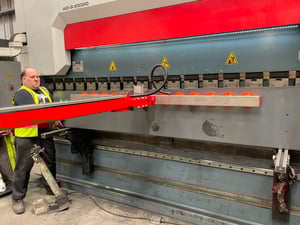
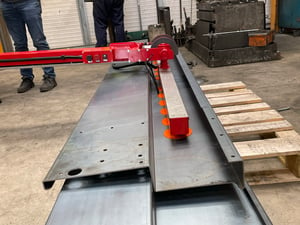
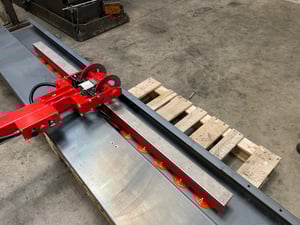
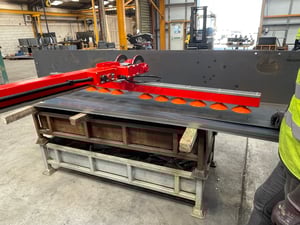
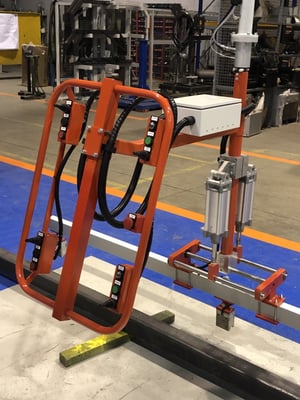
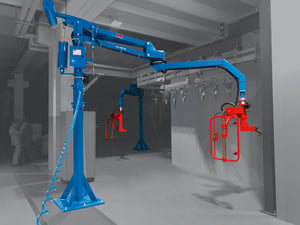
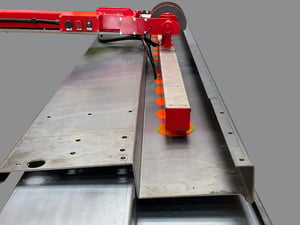
Thanks to their versatility and configuration options, RHS manipulators adapt to the demands of handling sheet metal in different industrial sectors.
Sheet metal moves fast and often on automotive lines: body panels and stamped components pass through multiple stations, where delay or damage at the handling stage ripples down the entire process.
Sheets tend to be larger and heavier in construction: cladding, roofing profiles, structural panels, frequently moved between storage, cutting, and loading in tight yard spaces.
In a job shop, sheet metal is one material among many, so equipment has to adapt to frequent changes in size and thickness rather than a single fixed product.
In a warehouse, the challenge shifts from processing to storage and dispatch: safely stacking, retrieving, and loading sheet stock without damaging edges or surfaces during transit.
Across all sectors, the common thread is the same: sheet metal is awkward to grip, easy to damage, and expensive to mishandle. That is why the equipment used to move it matters as much as the training given to the people moving it.
Gallery


.jpeg?width=300&name=WhatsApp%20Image%202024-01-25%20at%2018.56.36%20(1).jpeg)
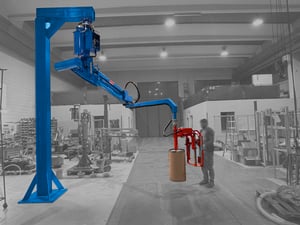
Floor-mounted or self-standing, ideal for fixed handling stations where an off-center load and repeated cycles call for stable, precise control.
Suspended from an existing structure or an independent frame, suited to static handling points where floor space for a column is not available.
Discover more
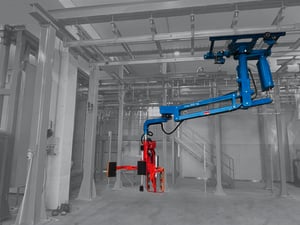
Travels along an overhead rail, moved manually or with pneumatic assistance, ideal where a single line serves several handling stations.
Discover how RHS sheet metal lifters can optimise your metal handling operations!
Contact RHS Italia for a custom sheet metal lifter solution