
A vacuum sack lifter built by RHS pairs a suction cup with a pneumatic manipulator: the operator guides the sack, the machine carries its weight. The grip comes from vacuum, the lift from a balancing system with a depression membrane, working through an articulated arm rather than a lifting tube, with a capacity of up to 200 kg (gripping tool excluded).
Two suction cups, three manipulator configurations and ATEX and 4.0 versions on request let every installation follow the layout of the plant, not the other way round.
On this page:
- Gripping systems for vacuum sack lifting
- Manipulators for your vacuum bag lifter
- Technical data and equipment
- Sectors that rely on a vacuum sack lifter
GRIPPING SYSTEMS FOR VACUUM SACK LIFTING
The suction cup is where the grip is decided. RHS builds two for bags, and what sets them apart is the power source behind the vacuum.
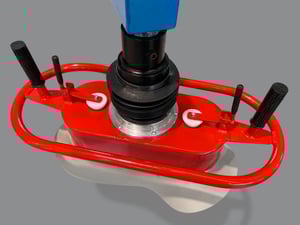
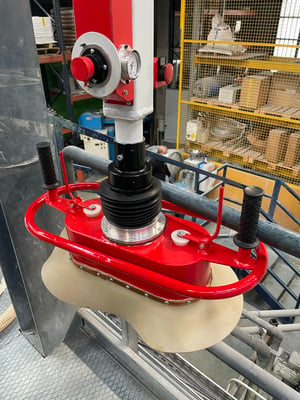
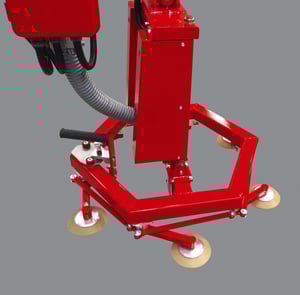
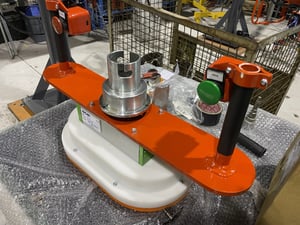
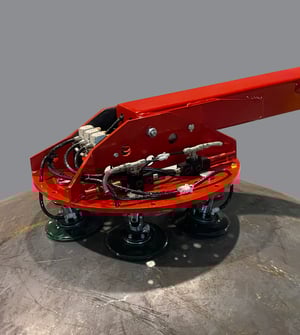
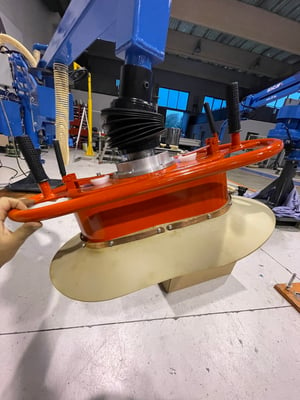
For more than 20 years the electric pump suction cup has been the RHS reference for bag handling. Its integrated vacuum pump overcomes the pressure difference between the suction cup and the aspirating system, and that is what keeps the grip firm when the sack is anything but flat. The rubber lower lip adapts to the irregular surface of a filled bag, while an internal net stops residues from being drawn into the circuit. Available in several sizes, it is suited to 90% of the bags handled worldwide.
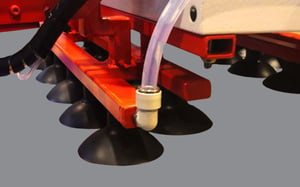
Where electricity itself is the hazard, the Venturi suction cup takes it out of the equation. It works without electrical power, pumps or solenoid valves, which makes it the natural choice for ATEX environments, where an ignition source can trigger an explosion. Fewer components also mean simpler upkeep: periodic maintenance is quick and easy, a concrete advantage on lines that cannot afford long stops.
Gallery
Manipulators for your vacuum bag lifter
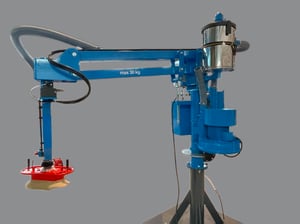
The suction cup grips; the manipulator decides where the sack can go. RHS builds the bag version in three configurations sharing the same core: electric pump, suction tube between vacuum pump and suction cup, electrical panel with thermostat for pump management and a balancing system with a depression membrane. What changes is how the machine is anchored and how far the operator can move with the load.
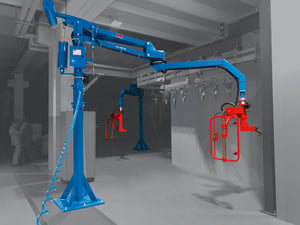
Floor-mounted or self-standing, the column manipulator is built for the fixed workstation, where stability matters more than reach. Its arm rotates 360° around the main axis, so the operator can serve several points around a single anchor without carrying the load across the floor.
Application example: sacks picked from a pallet next to the station and placed on a hopper, a mixer inlet or a bag-tipping shelf, cycle after cycle, with the operator’s effort reduced to guiding the load.
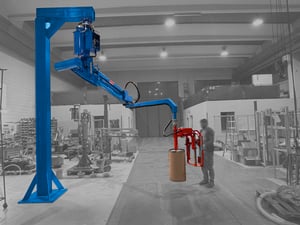
When the floor is occupied by pallets or conveyor belts, the fixed ceiling-mounted manipulator moves the mounting bracket into a raised position. Its suspension system can be adapted to existing structures or designed for independent installation.
Application example: depalletising sacks onto a conveyor in a crowded area, where a column base would take room away from the flow of materials.
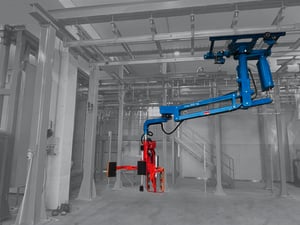
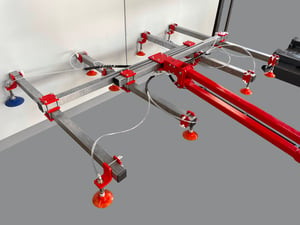
Where sacks travel along a line rather than around a point, the sliding ceiling manipulator runs on rails, moved by hand or with a pneumatic motor controlled by the operator. The trolley can be free or motorised, depending on distances and cycle times.
Application example: picking sacks from a row of pallets to feed several stations in sequence, or palletising at the end of a packing line across a wide working area.
Share the layout of your area: our team will tell you which anchoring makes the most of it.
Technical data and equipment
The three configurations share the same technical base. The data below refers to the bag manipulator; working range and radius are defined project by project.
|
Parameter |
Value |
|
Supply |
7-bar compressed air |
|
Max load capacity |
200 kg (gripping tool excluded) |
|
Machine mass |
220 to 250 kg |
|
Main axis rotation |
360° |
|
Second axis rotation |
330° |
|
Vertical range |
1,600 to 2,200 mm |
|
Max radius |
2,000 to 4,000 mm |
|
Min radius |
300 to 700 mm |
|
Standard colour |
RAL 5015 |
|
Base plate (column version) |
600 × 600 mm, 30 mm thick |
An accumulation tank keeps air available even when pneumatic power is missing. The bag manipulators can be fitted with a dust collection system and an external noise reducer, and they include passive safety systems for emergency situations. ATEX and 4.0 versions are available on request.
Sectors that rely on a vacuum sack lifter
Sacks travel through very different plants, and each sector brings its own constraint: regulation, weight, explosion risk. These are the industries where RHS bag handling works hardest.
In a highly regulated, high-risk industry, RHS manipulators handle bags alongside drums and containers, with the robustness operational safety depends on.
Cement bags sit alongside bricks, glass and metal slabs: as a cement bag lifter, the bag version takes the repetitive heavy lift off the operator.
RHS manipulators handle bags, with both free and motorised trolley configurations.
Where sparks and ignition sources are ruled out, the Venturi suction cup and ATEX versions keep sack handling within safe limits
Design your vacuum sack lifter with RHS
Every sack line is different: weight, bag format, pallet height, the space around the station. Send us a photo of the sack you handle and a few details about the workstation, and our team will propose the pairing of suction cup and manipulator that fits it. If you already have a clear picture, the online configurator lets you build your manipulator step by step.
Can't find the vacuum sack lifter you need?
Send us a photo of your sack: we will come back with a configuration built around it.
Are you looking for the most effective and innovative solution on the market?
Fill out the form and one of our experts will contact you as soon as possible.